On the Validity of the Novus Ordo and the Impossibility of Eucharistic Confection Outside the Sacred Liturgy
A Reply to a Common Traditionalist Objection
I. Introduction
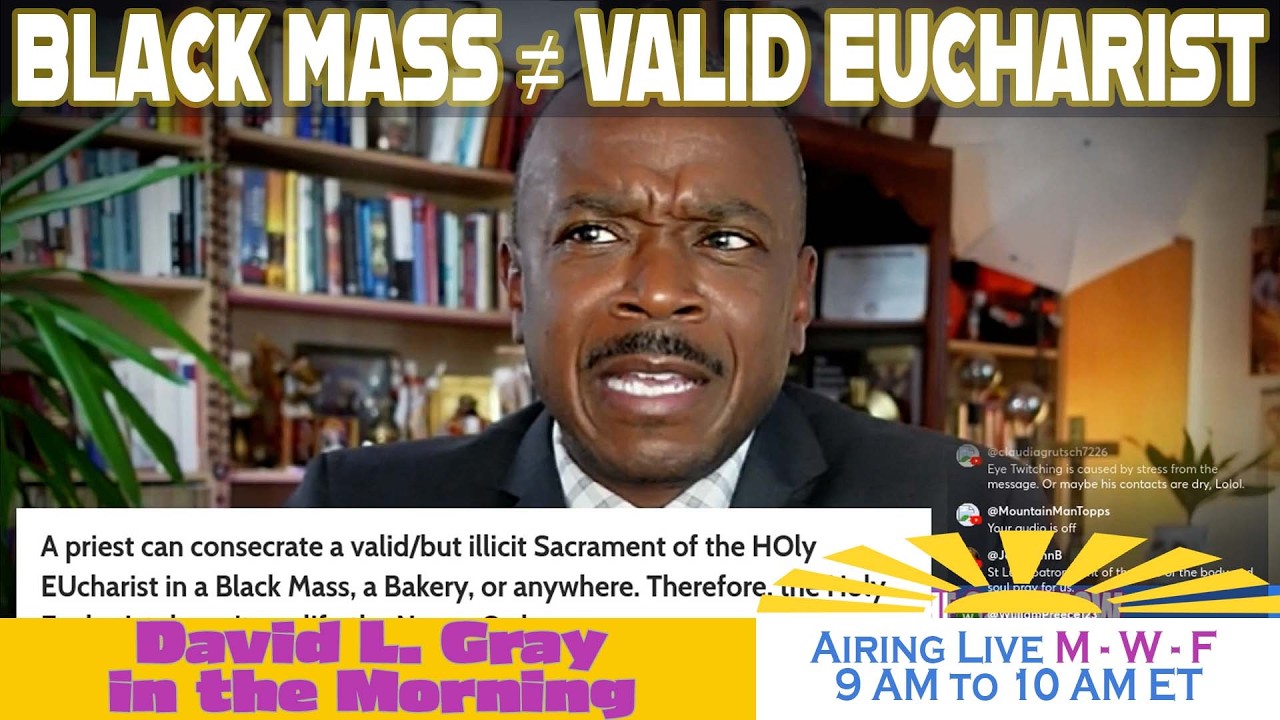
A recurring polemic encountered in certain traditionalist circles (I have come to describe as the “toxic trad” position) holds that the ordinary form of the Roman Rite, the so-called Novus Ordo Mass, is fundamentally defective, and that, as a corollary, a validly ordained priest may confect the Holy Eucharist outside the liturgy altogether: in a bakery, on a tabletop, or, in the most provocative formulation, within a Black Mass. The argument is rhetorically arresting precisely because it appears to derive a sweeping ecclesiological conclusion from a narrow sacramental premise. If, the reasoning runs, the priest’s words alone suffice to confect the Eucharist, then the surrounding liturgical form is a matter of mere ornament, and the reformed Roman Mass is, at best, an aesthetic indulgence and, at worst, an unnecessary one.
The argument is mistaken at every level. It rests upon a non sequitur and a series of false premises about what constitutes the form of the sacrament. Answering it requires first clarifying what may legitimately be conceded about the ordinary form, and then setting out the sacramental, canonical, and conciliar reasons why the Holy Eucharist cannot be confected outside the celebration of the Mass.
II. What May Be Conceded, and What May Not
It is necessary to grant at the outset that the ordinary form of the Mass is a valid Mass, and that Christ truly becomes present in it under the appearances of bread and wine. The Eucharistic Lord visits this liturgy as he visits every valid celebration of the Roman Rite. From this it follows that whatever aesthetic or pastoral criticisms may be leveled against the ordinary form (and the present author is willing to entertain a number of them), the sacrament itself is not in doubt. The reformed liturgy, in many of its concrete celebrations across the contemporary Church, has been impoverished in its sense of the sacred, in its musical patrimony, and in its ritual gravity. To call it, in such instances, ugly is not in itself a heresy.
Yet this concession does not entail the conclusion the polemicist wishes to draw. That God draws near to ugly situations is, in fact, the central testimony of the Incarnation and of the entire economy of grace. He comes to ugly people (the prideful, the avaricious, the indifferent), and he comes to them not despite their disfigurement but in order to heal it. The descent of Christ into the inelegant or the impoverished is no scandal to the Christian imagination; it is its very logic. To argue that the ordinary form must be invalid because it is, in some celebrations, aesthetically lacking is to mistake an accidental feature for a substantial defect, and to deny in liturgical practice what we affirm in soteriology.
III. The Polemical Claim and Its False Premise
The polemic typically proceeds as follows. Because (it is alleged) a priest can consecrate the Eucharist anywhere, whether in a bakery by accident or, in the most extreme formulation, within a Black Mass, the surrounding liturgical context is theologically irrelevant. Therefore, the ordinary form of the Mass, as an elaborated liturgical context, is itself irrelevant or worse. The aesthetic critique is then enlisted in service of an ontological one.
The argument’s rhetorical force masks a basic confusion. It is not, in the first instance, an attack on the ordinary form alone. By asserting that Christ may be brought to be in a Black Mass, the polemicist makes a claim about Christ himself, and about the sacramental constitution of his Church. The claim is not merely uncharitable but demonic in its implication: it places the Lord at the disposal of those who explicitly intend his desecration. That alone is grounds for repudiation. But the argument also fails on its technical merits, to which the rest of this essay turns.
IV. Validity, Liceity, and the Distinction the Argument Elides
The polemic depends upon a conflation of two distinct categories that the Church has long held apart. Validity concerns whether the sacrament exists at all, that is, whether, when the rite is performed, the sacramental reality has been brought about. Liceity, by contrast, concerns whether the sacrament has been celebrated lawfully and in due ecclesial order. The two are related but not identical: a sacrament may, in extraordinary circumstances, be valid yet gravely illicit. Yet the existence of this distinction is not a license to treat the licit form of the liturgy as theologically optional. The argument that a priest can, under certain unusual conditions, validly celebrate while violating liceity becomes, without warrant, the argument that the licit form is dispensable. The non sequitur is the engine of the entire polemic.
To observe that a physician could, in a true emergency, perform a life-saving intervention in a parking lot is not to conclude that hospitals are irrelevant to the practice of medicine. The exception is precisely the exception. So too in sacramental theology: the Church has always recognized that licit and ordinary celebration is the rule, and that any departure from it requires both grave cause and a careful preservation of the sacrament’s essential constitution.
V. The Witness of Canon Law
The canonical tradition is decisive on the point in question. The 1983 Code of Canon Law specifies in canon 900 that only a validly ordained priest can confect the Eucharist[1], a minimum requirement for validity, but by no means the only one. The same canon, in its second paragraph, requires that the priest celebrate the Eucharist in communion with the Church and according to approved liturgical books[2]. Already this is fatal to the polemicist’s claim, for a Black Mass is by definition not in communion with the Church and is conducted according to no approved liturgical book.
More pointedly still, canon 927 declares that it is absolutely forbidden, even in extreme necessity, to consecrate one matter without the other or to do so outside the Eucharistic celebration[3]. The legislator’s language is uncommonly absolute: there is no condition under which the canonical order envisions the confection of the Eucharist apart from the Eucharistic celebration itself. The form of the Mass is not a setting in which the consecration happens to occur; it is the indispensable matrix within which the sacrament comes to be.
VI. The Witness of the Council
The Second Vatican Council, in its constitution Sacrosanctum Concilium, articulates the same theological vision. The sacred liturgy is the exercise of the priestly office of Jesus Christ[4], a description that the Black Mass not only fails to instantiate but explicitly inverts. Further, the constitution insists that no one, not even a priest, may add, remove, or change anything in the liturgy on his own authority[5]. The reformed rite of Paul VI, far from being a private project, is the Church’s own promulgated liturgy; precisely because it is so, it is always valid when celebrated by a duly ordained priest with the right intention.
The Council’s emphasis falls upon the ecclesial character of the Eucharist. The sacrament is not the private act of an individual priest but the act of the Church itself, made present in and through her ordained ministers. A clandestine ritual conducted in defiance of the Church, against her intention and outside her communion, cannot be the act of the Church. It is therefore not, and cannot be, the Eucharist.
VII. The Four Requirements of Sacramental Theology
Classical sacramental theology identifies four requirements for the valid confection of the Eucharist. The first is valid matter: true wheat bread and true grape wine. The second is valid form, which, contrary to a recurring misunderstanding among the polemicists, is not reducible to the bare words of institution but consists in the entire rite of the Mass as the Church has constituted it. The third is a valid minister: a priest who has not only valid orders but also a canonical mission, ordinarily mediated through the bishop in whose territory he ministers. A priest visiting another diocese must, for liceity, request the faculties of the local ordinary; his hands remain consecrated, but the legitimacy of his ministry depends upon ecclesial communion. The fourth is right intention, which the tradition expresses as the intention to do what the Church does[6].
Each of these requirements bears upon the cases the polemic raises. The priest in a Black Mass does not intend to do what the Church does; he intends precisely the opposite. The point is not subtle. A baptism conferred “in the name of Charlie Brown, Mickey Mouse, and Miss Piggy” is invalid not because the words sound silly but because the minister has not intended to do what the Church does. The Black Mass stands in a still graver relation to sacramental intention: it is mockery and inversion. It cannot, by definition, supply the intention that validity requires.
The case of the priest who wanders into a bakery and pronounces the words of institution over a loaf is even more straightforwardly excluded. The intention is absent or malformed; the form is absent, since the rite of the Mass is not being celebrated; and the matter, in all probability, is not the unleavened wheat bread that the Latin tradition requires. Three of the four conditions fail simultaneously.
VIII. The Eucharist as Preternatural to the Mass
A metaphor may help. Among the various modes of Christ’s presence enumerated by the tradition (his presence in the Sacred Scriptures, in the gathering of the faithful in prayer, in the priest acting in persona Christi, and most fully in the Eucharistic species), only the last is what one may call preternatural to the Mass. The Scriptures exist apart from the liturgy; the priest is ordained outside it; the gathered faithful pray in many places. These presences come to be elsewhere and are then brought into the liturgical assembly. The Eucharistic presence, by contrast, has no other point of origin. It is born in the Mass and only in the Mass.
The Holy Eucharist can no more come to be outside the form of the Mass than human life can come to be outside the womb of a woman. The biological analogy may not hold indefinitely against the advance of medical technology, but the sacramental analogy holds without qualification. The liturgy is not merely the conventional setting of the consecration; it is its proper and indispensable matrix.
IX. Why the Argument Persists, and Why It Should Be Rejected
The persistence of the polemic owes more to its rhetorical utility than to any theological merit. By invoking extreme cases (the Black Mass, the bakery), the polemicist seeks to detach the Eucharist from the ordinary form, in order to render that form a matter of taste rather than of sacramental necessity. The implicit conclusion is that the reformed liturgy may be despised without consequence to one’s eucharistic faith.
The actual logic of the position is the reverse of what its proponents suppose. To assert that the Eucharist may be confected in a Black Mass is, in the order of doctrine, to assault not the ordinary form but Christ in his Church. It denies the ecclesial character of the sacrament, the Church’s authority over her own liturgical life, and finally that the sacraments are the acts of the Church at all. What presents itself as a defense of the older rite is in fact an attack on the constitution of the sacramental economy as such.
X. Conclusion
The ordinary form of the Roman Rite is the Church’s own liturgy, promulgated by the supreme legislative authority within her, and is therefore always valid when its essential conditions are met. Whatever criticisms may be made of particular celebrations (and many such criticisms can be made in good faith) cannot be parlayed into a denial of the sacrament. The further claim that the Eucharist may be confected outside the liturgy, whether by the negligence of a wandering priest or by the malice of a sacrilegious rite, is excluded by the unanimous testimony of canon law, conciliar teaching, and classical sacramental theology. The Holy Eucharist is preternatural to the Mass. It is born there, and there alone.
To recognize this is not to absolutize one liturgical form against another, nor to silence legitimate questions about how the reformed rite is celebrated and received. It is, rather, to refuse the sleight of hand by which a polemic against the ordinary form is converted, by stages, into a polemic against the sacramental constitution of the Church herself. The Lord who comes to ugly people in their ugliness comes also to a sometimes ugly liturgy. He does not come where his Church does not act.
[1]Code of Canon Law (1983), can. 900 §1: “The minister, who in the person of Christ can confect the sacrament of the Eucharist, is a validly ordained priest alone.”
[2]Ibid., can. 900 §2.
[3]Ibid., can. 927: “It is absolutely forbidden, even in extreme urgent necessity, to consecrate one matter without the other or even both outside the eucharistic celebration.”
[4]Second Vatican Council, Sacrosanctum Concilium (1963), §7.
[5]Sacrosanctum Concilium, §22 §3: “Therefore no other person, even if he be a priest, may add, remove, or change anything in the liturgy on his own authority.”
[6]St. Thomas Aquinas, Summa Theologiae III, q. 64, aa. 8–10, on the necessity of right intention in the minister of the sacraments.