Should You Pray the Rosary During Mass? What Pius XII & Aquinas Actually Taught
A deep dive into Mediator Dei, participatio actuosa, and the true meaning of the liturgy
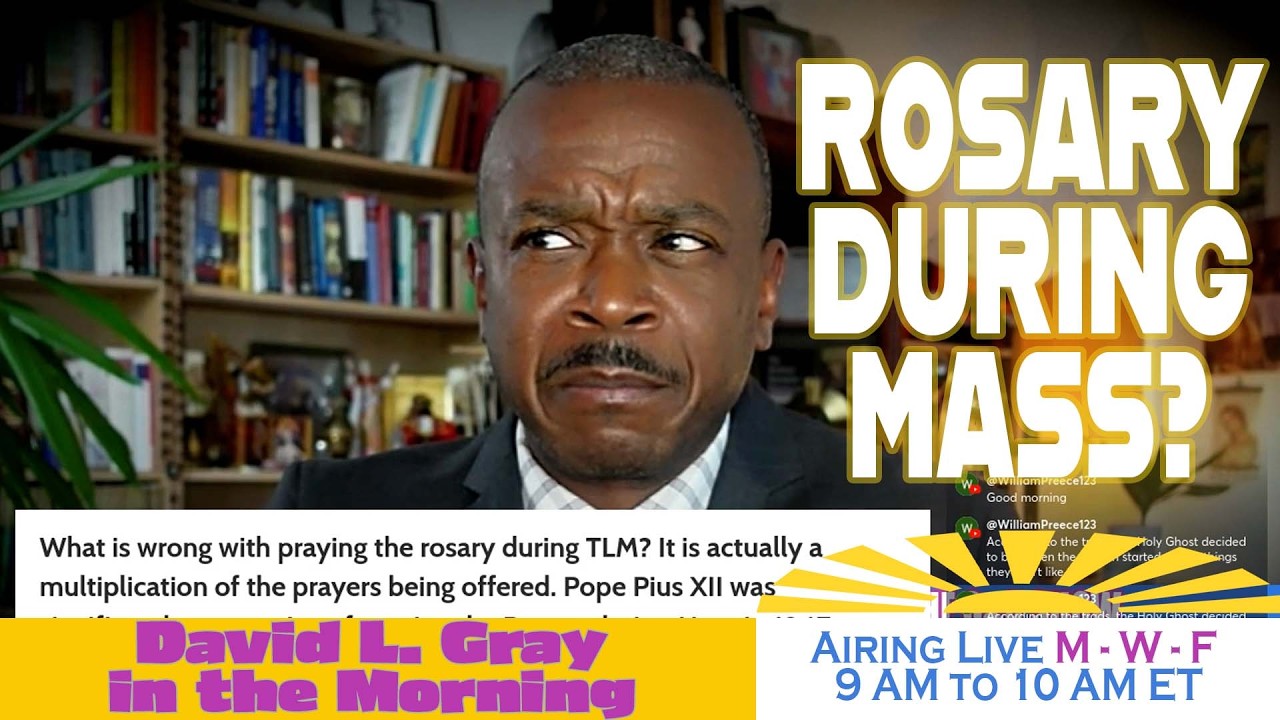
Few questions in Catholic liturgical life generate more heat than this one: Is it appropriate to pray the Rosary during the Traditional Latin Mass? On the surface, it seems like a matter of personal piety — after all, isn’t any prayer directed to God a good thing? But the answer requires us to go deeper: into the actual words of Pope Pius XII, into the theology of St. Thomas Aquinas, and into the very nature of what the liturgy is and does.
The argument for praying the Rosary during Mass is, on its face, a clever one. Pius XII, in his encyclical Mediator Dei (1947), did acknowledge that the faithful are sometimes unable to use the Roman Missal and therefore engage in private devotions during the celebration of the liturgy. And Aquinas, in his treatment of the altar server’s role, observed that the server answers on behalf of the entire people, which might seem to free the laity to pursue their own private prayer while the server handles the responses. Taken together, one might conclude that silent private devotion, even the Rosary, is perfectly acceptable during Mass.
But this reading misses the mark, and it misreads both authorities. Pius XII, in the very same passage where he acknowledges private devotions, immediately adds that the faithful should not be considered “strangers or silent spectators” at the Mass. His acknowledgment of the practice was not an endorsement — it was a pastoral concession in response to a widespread problem of liturgical illiteracy. The faithful were praying the Rosary during Mass precisely because they did not understand what the Mass was. Pius XII named this a deficiency, not a virtue, and placed the burden squarely on priests, bishops, and theologians to draw the laity more deeply into the sacred action.
This is, in fact, exactly what the liturgical reform movement of the late nineteenth and early twentieth centuries sought to address. Long before the Second Vatican Council, reformers looked out at congregations praying their own private devotions during Mass, the Rosary, novenas, personal meditations, and recognized a profound disconnect. The liturgy was happening at the altar, and the people were somewhere else entirely in their interior lives. The reformers did not primarily seek the vernacular or a simplified rite. Their central concern was participatio actuosa — active participation. They wanted the faithful to be consciously united to the sacrifice unfolding before them, not retreating into a private devotional world of their own. And yet, despite decades of liturgical reform, the laity have remained largely disconnected from the mystery, meaning, and purpose of the Mass. In that sense, both the traditional reformers and the post-conciliar reformers arrived at the same frustrating destination.
To understand why private devotions during Mass miss the point, we must first understand what the liturgy actually is. The liturgy is not a container for private prayer, nor is it a backdrop against which the faithful pursue their own interior devotions. The liturgy is worship. It is Christ speaking. It is sacrifice and offering. It is prayer delivered through Jesus Christ, focused not on the human person but on God. It is engagement, encounter, and mission, and that last element is crucial: one of the principal purposes of the liturgy is not to keep us in it, but to send us from it formed and transformed. The highest good the Mass achieves is not that we remain within its walls, but that we go out from it as different people, shaped by what we have received. The liturgy is also revelation and active participation, and the question of who participates and how is at the very heart of what we must answer.
When we say the liturgy is Christ speaking, every distraction from that becomes something more than merely suboptimal; it becomes a kind of rudeness toward Christ. A child coloring in a pew, an adult scrolling a phone during the readings, a parishioner praying the Rosary while the Eucharistic Prayer unfolds at the altar: each of these is a turning away from the One who is speaking, offering, and uniting. The Holy Rosary is a high sacramental and a venerable form of prayer, but it is not the Mass. The Mass is our highest form of prayer. When we substitute a lesser prayer for the greater one during the very moments the greater one is being offered, we deprive our souls of what is most good. We distract ourselves from a sacramental encounter with Christ, from the very thing the liturgy was designed to accomplish in us.
The Church tolerates the ignorance that produces these behaviors because grace is present simply by showing up. But tolerance is not the same as affirmation, and presence is not the same as participation. Pius XII did not endorse praying the Rosary during Mass. He described a pastoral reality and immediately called the Church beyond it. The tradition of private devotions during the liturgy reflects not a richness of Catholic piety but a poverty of liturgical understanding, one that the Church has been trying to remedy for well over a century. The ideal is not private devotion. The ideal is the liturgical life: a life formed by conscious, active, interior union with the sacrifice of Christ, beginning at the altar and extending outward into everything we are and do.